Natural Stone Finishes: A Complete Selection Guide
Natural stone finish influences far more than the appearance of a surface. It affects how the stone feels underfoot, how strongly its color and veining appear, how easily it can be cleaned and how it performs in wet or high-traffic areas.
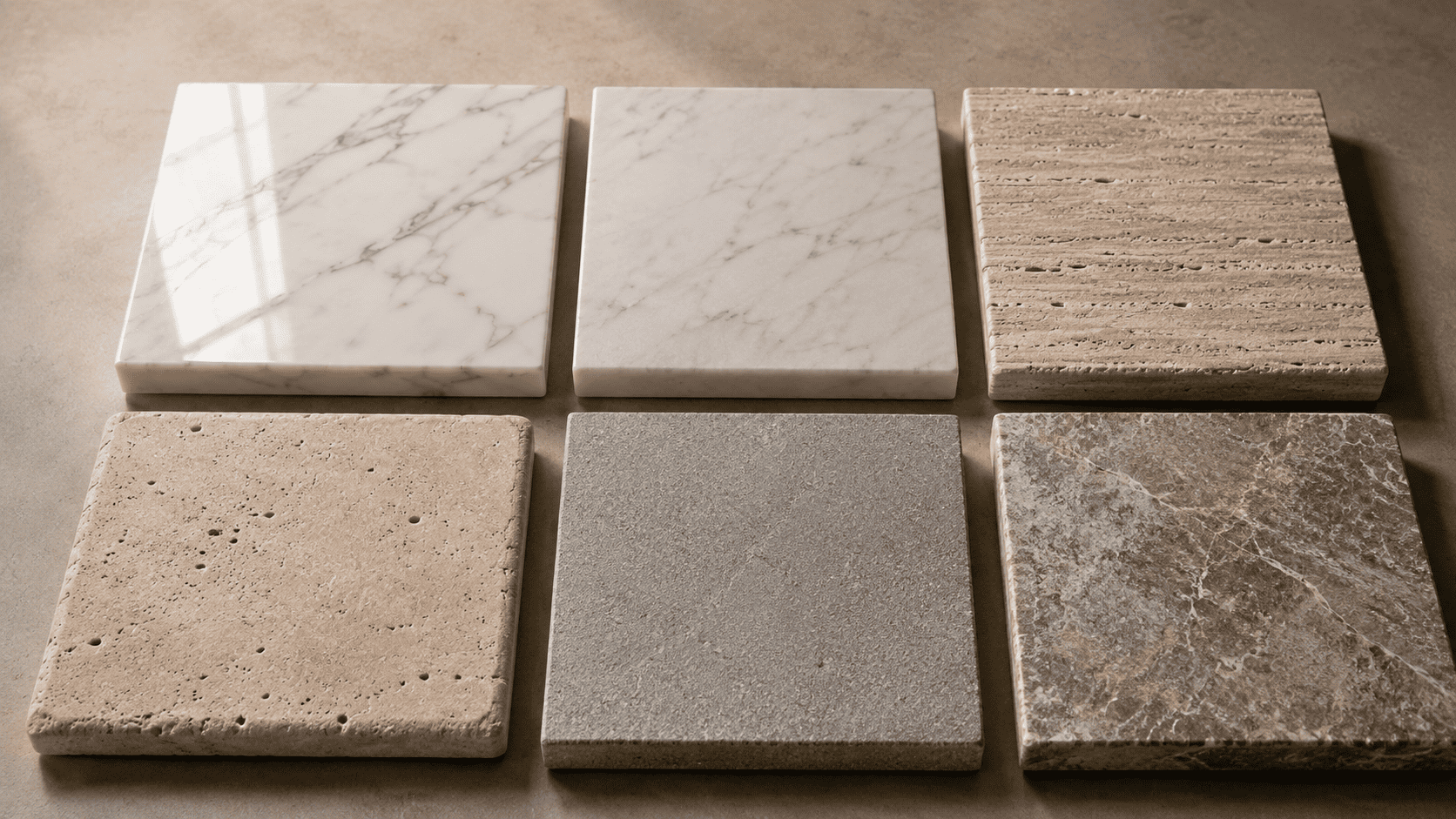
Table of Contents
- Why Is the Natural Stone Finish Important?
- Polished Natural Stone Finish
- Where Is Polished Stone Used?
- Advantages of a Polished Finish
- Points to Consider
- Honed Natural Stone Finish
- Where Is Honed Stone Used?
- Advantages of a Honed Finish
- Points to Consider
- Honed vs Polished Marble
- Brushed Natural Stone Finish
- Where Is Brushed Stone Used?
- Advantages of a Brushed Finish
- Points to Consider
- Tumbled Natural Stone Finish
- Where Is Tumbled Stone Used?
- Advantages of a Tumbled Finish
- Points to Consider
- Sandblasted Natural Stone Finish
- Where Is Sandblasted Stone Used?
- Advantages of a Sandblasted Finish
- Points to Consider
- Patinato Natural Stone Finish
- Where Is Patinato Stone Used?
- Advantages of a Patinato Finish
- Points to Consider
- Natural Stone Finish Comparison
- Choosing a Finish by Application
- Hotel Lobbies and Reception Areas
- Bathrooms and Shower Areas
- Kitchens and Countertops
- Corridors and High-Traffic Interiors
- Terraces and Walkways
- Pool Surroundings
- Exterior Façades
- How Does the Finish Affect Cleaning and Maintenance?
- Does a Textured Finish Make Natural Stone Slip-Resistant?
- What Should Be Checked Before Ordering?
- Request Natural Stone Finish Samples
Need help choosing the right stone?
Let our expert team help you choose the ideal natural stone for your project.
Natural stone finish influences far more than the appearance of a surface. It affects how the stone feels underfoot, how strongly its color and veining appear, how easily it can be cleaned and how it performs in wet or high-traffic areas.
Polished, honed, brushed, tumbled, sandblasted and patinato finishes each create a different relationship between the stone and its surroundings. A polished marble floor can make a hotel lobby feel brighter and more refined, while brushed travertine can bring warmth and texture to an outdoor terrace.
The right finish should therefore be selected according to the stone type, application area, expected traffic, exposure to water and desired design language.
This guide compares the most widely used natural stone finishes and explains how to choose the appropriate surface for residential, commercial and hospitality projects.
Why Is the Natural Stone Finish Important?
Surface finishing changes the uppermost layer of natural stone through mechanical processing. Depending on the selected treatment, the same marble, travertine or limestone can appear glossy, matte, textured or aged.
The finish can influence:
Color depth and vein visibility
Surface reflectivity
Tactile character
Cleaning requirements
Visibility of scratches and wear
Slip resistance
Suitability for interior or exterior use
Overall architectural style
A finish does not change the fundamental geological properties of the stone. Factors such as porosity, mineral composition, thickness and structural suitability must still be evaluated separately.
Designers and contractors can explore available formats through the Tureks natural stone collections before comparing finish alternatives for a project.
Polished Natural Stone Finish
A polished finish creates a smooth and highly reflective surface. Progressive grinding and polishing processes reveal the depth of the stone’s color and make its natural veining more prominent.
Polished marble is frequently selected for luxury interiors because it reflects light and creates a visually refined atmosphere. It is especially effective in spaces where the natural pattern of the stone is intended to become a focal point.
Where Is Polished Stone Used?
Polished surfaces are commonly considered for:
Hotel lobbies
Reception desks
Interior wall cladding
Decorative wall panels
Bathroom vanity tops
Kitchen countertops
Fireplace surrounds
Low-risk interior flooring
The suitability of polished stone for flooring must be assessed according to expected traffic and exposure to water. A glossy surface may become slippery when wet and can display scratches or traffic paths more clearly over time.
Explore marble tiles and natural stone slabs for polished interior applications.
Advantages of a Polished Finish
Enhances color and veining
Reflects natural and artificial light
Creates an elegant, formal appearance
Provides a smooth surface that can be wiped easily
Works effectively on decorative walls and countertops
Points to Consider
Acidic substances can etch calcite-based stones such as marble, travertine and limestone. Etching may be more visible on a polished surface because it creates a dull area against the surrounding gloss.
Polished floors may also require additional evaluation in entrances, bathrooms and other areas where water can reach the surface.
Honed Natural Stone Finish
A honed finish creates a smooth surface with a matte or satin appearance. It is produced before the stone reaches the high-gloss stage associated with polishing.
Honed marble provides a softer and more understated appearance. Its low reflectivity works particularly well in contemporary interiors, large floor areas and spaces where designers want the stone to support the overall composition without creating strong glare.
Where Is Honed Stone Used?
Honed finishes are widely used for:
Residential flooring
Commercial interior floors
Bathroom walls
Shower walls
Kitchen backsplashes
Countertops
Hotel corridors
Feature walls
Products such as Glacier Marble are available in honed and polished alternatives, making it possible to compare both finishes within the same stone family.
Advantages of a Honed Finish
Creates a calm and contemporary appearance
Reduces glare under strong lighting
Makes minor surface wear less noticeable than a polished finish
Preserves a smooth and comfortable texture
Works across both traditional and modern projects
Points to Consider
Honed stone is not automatically slip-resistant. Its performance depends on the stone, finishing level, installation method, contaminants and testing conditions.
A honed surface may also display oils, fingerprints or darkened areas differently from a polished surface. Correct sealing and cleaning procedures should be determined with the supplier before installation.
Honed vs Polished Marble
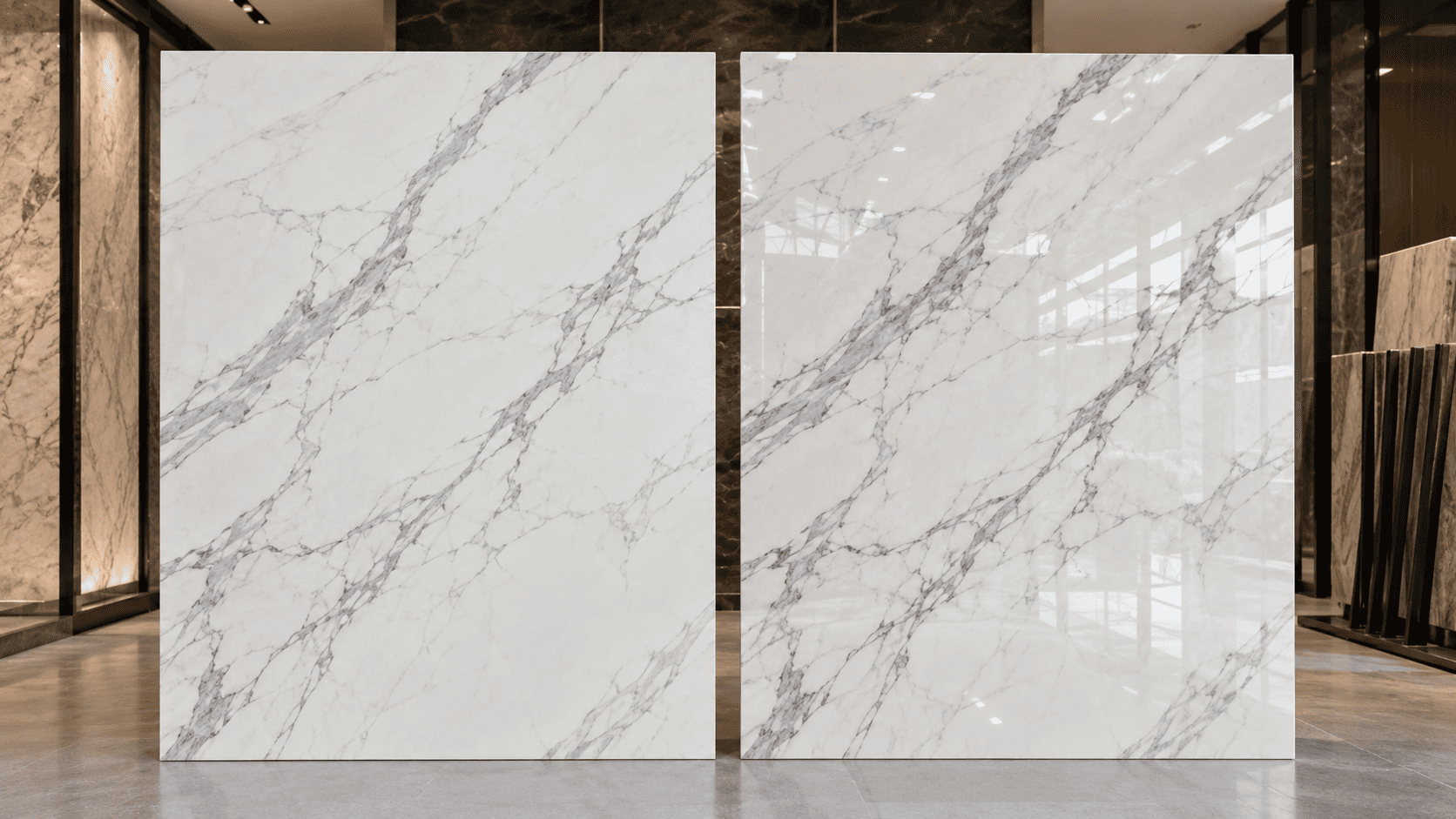
The difference between honed and polished marble is primarily related to reflectivity, texture and the way the surface responds to everyday use.
| Selection Criterion | Honed Marble | Polished Marble |
|---|---|---|
| Appearance | Matte or satin | Glossy and reflective |
| Color Expression | Softer and more muted | Deeper and more vivid |
| Vein Visibility | Subtle | More pronounced |
| Light Reflection | Low | High |
| Wear Visibility | Generally less noticeable | Traffic and scratches may appear more clearly |
| Typical Applications | Floors, bathrooms, corridors and contemporary interiors | Walls, lobbies, counters and formal interiors |
| Wet-Area Use | Requires slip testing | Requires careful slip evaluation |
| Cleaning | May show oils or marks depending on the stone | Smooth surface is easy to wipe, but etching is more visible |
Choose polished marble when strong color, reflective light and a formal aesthetic are the main priorities. Choose honed marble when the project requires lower reflectivity, a softer visual character and a surface that can conceal minor wear more effectively.
The final choice should be made using physical samples viewed under the project’s actual lighting conditions.
Brushed Natural Stone Finish
A brushed finish has a softly textured and tactile surface. Mechanical brushes remove softer particles from the stone and emphasize its natural structure without creating the pronounced roughness associated with heavier exterior treatments.
Brushed travertine is particularly popular because the finish complements the stone’s organic movement and warm character. It can be used to create relaxed Mediterranean, rustic or contemporary environments.
Where Is Brushed Stone Used?
Brushed finishes may be considered for:
Terraces
Patios
Pool surroundings
Garden paths
Entrance areas
Bathroom floors
Rustic interior flooring
Exterior wall cladding
Discover travertine products and travertine tiles for brushed surface alternatives.
For a product-level example, review the Ivory Brushed Travertine Tile.
Advantages of a Brushed Finish
Provides a natural and tactile appearance
Adds visual depth without high reflectivity
Complements travertine and limestone particularly well
Can make minor wear less visually dominant
Supports transitions between indoor and outdoor spaces
Points to Consider
The textured surface can retain more dust and residue than a polished surface. Cleaning tools and maintenance routines should be selected according to the texture depth and installation environment.
Slip performance must be confirmed through appropriate testing when brushed stone is intended for wet or exterior floors.
Tumbled Natural Stone Finish
A tumbled finish gives natural stone an aged and time-worn appearance. The process softens edges and creates subtle surface variation, making each piece feel less uniform and more traditional.
Tumbled travertine and limestone are commonly used in projects inspired by historic, Mediterranean or rustic architecture.
Where Is Tumbled Stone Used?
Tumbled stone is suitable for applications such as:
Courtyards
Garden paths
Pool decks
Patios
Traditional kitchens
Bathroom floors
Feature walls
Rustic interior floors
The Walnut Dark Tumbled Travertine Paver demonstrates how a tumbled finish can be combined with a Versailles pattern for outdoor and transitional spaces.
Advantages of a Tumbled Finish
Creates an aged and authentic appearance
Softens the visual effect of tile edges
Complements modular and Versailles patterns
Makes natural variation part of the design
Works particularly well with travertine and limestone
Points to Consider
Tumbled products can have irregular edges and dimensional variation. Joint width, grout color and installation layout should be confirmed during sample approval.
The naturally aged appearance should not be confused with damage. Clients should review multiple pieces rather than approving the material from a single sample.
Sandblasted Natural Stone Finish
A sandblasted finish creates a fine, granular texture by directing abrasive material against the stone surface. The resulting surface is matte and visibly textured.
This finish is often considered for exterior applications because it reduces reflectivity and provides a stronger tactile character than polished or lightly honed surfaces.
Where Is Sandblasted Stone Used?
Common applications include:
Exterior walkways
Pool surroundings
Public plazas
Building entrances
Steps
Ramps
Exterior façades
Landscape applications
Advantages of a Sandblasted Finish
Produces a consistent matte texture
Reduces glare in sunny environments
Supports exterior and landscape design
Makes large paved areas appear visually cohesive
Can provide greater surface texture than smooth finishes
Points to Consider
A textured surface is not a universal guarantee of slip resistance. The selected stone and finished product should be tested under relevant wet and dry conditions.
Sandblasted surfaces may retain dirt more readily than smooth finishes. Cleaning methods should be tested on a sample area to avoid altering the texture or color of the stone.
Patinato Natural Stone Finish
Patinato is an aged and tactile natural stone finish designed to create visual depth and a gently weathered character. The exact production method can vary according to the producer, stone type and required texture.
It may combine controlled mechanical processes that soften selected areas while preserving a naturally uneven surface. For this reason, patinato samples should be evaluated in person before the finish is included in a project specification.
Where Is Patinato Stone Used?
Patinato surfaces can be considered for:
Feature walls
Hotel and restaurant interiors
Entrance halls
Fireplace surrounds
Interior floors
Exterior wall cladding
Transitional indoor and outdoor areas
Advantages of a Patinato Finish
Creates an artisanal and distinctive appearance
Highlights the natural movement of the stone
Supports rustic and contemporary design concepts
Provides more texture than a conventional honed finish
Makes every installation appear individual
Points to Consider
“Patinato” may not describe exactly the same texture across every supplier or stone collection. Approved control samples should therefore become part of the order and production documentation.
Natural Stone Finish Comparison
| Finish | Visual Character | Texture | Cleaning Requirement | Common Applications |
|---|---|---|---|---|
| Polished | Glossy, vivid and formal | Very smooth | Easy to wipe, etching and wear can be visible | Interior walls, lobbies, counters |
| Honed | Matte, soft and contemporary | Smooth | Routine neutral cleaning | Interior floors, bathrooms, corridors |
| Brushed | Natural and tactile | Lightly textured | Texture may require more detailed cleaning | Terraces, bathrooms, indoor and outdoor floors |
| Tumbled | Aged, rustic and traditional | Textured with softened edges | Joints and cavities require attention | Patios, paths, pool decks |
| Sandblasted | Uniform, matte and architectural | Granular | Textured surface may retain dirt | Exterior floors, steps, façades |
| Patinato | Weathered, layered and distinctive | Variable texture | Depends on texture depth | Feature surfaces, floors and wall cladding |
Choosing a Finish by Application
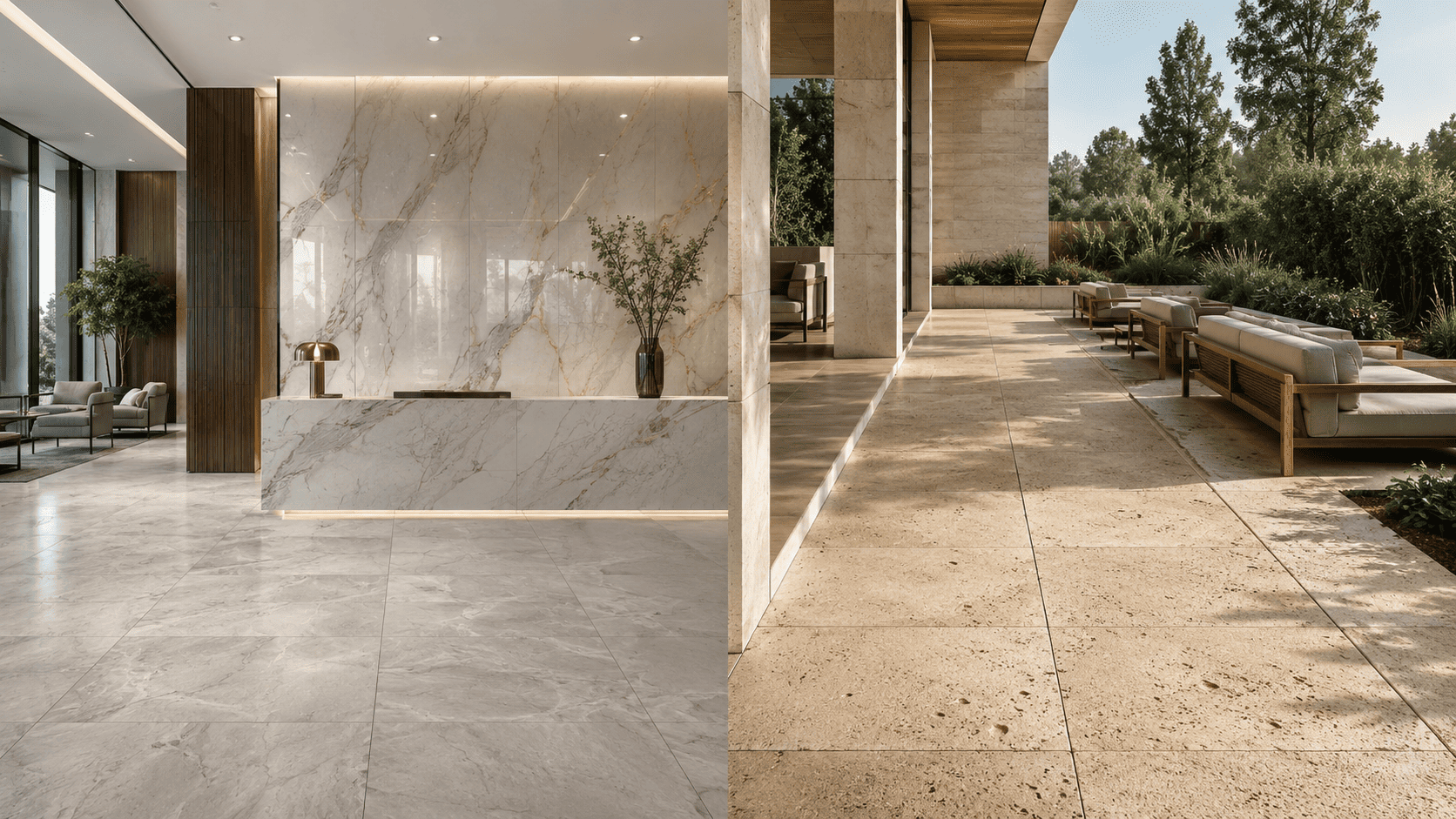
Hotel Lobbies and Reception Areas
Polished marble can create a bright and prestigious entrance, particularly on walls, reception counters and selected floor areas. Honed marble may be preferred where lower reflectivity and easier visual management of traffic are required.
Entrance zones should be assessed separately because rainwater, dust and external contaminants can change floor performance.
Bathrooms and Shower Areas
Honed, brushed, tumbled or small-format mosaic surfaces may be considered depending on the design. Wet-area selection should be supported by slip testing, drainage planning and correct installation.
A finish that performs well on a bathroom wall may not be suitable for a shower floor.
Kitchens and Countertops
Polished and honed slabs are the most common choices for countertops and kitchen islands. Polished stone emphasizes color and veining, while honed stone creates a softer appearance.
Both finishes require appropriate care when used with calcite-based materials. Acidic food and cleaning products can affect marble, limestone and travertine surfaces.
Browse natural stone slabs for countertop, island and large-format wall applications.
Corridors and High-Traffic Interiors
Honed or lightly textured finishes can make surface wear less visible than a high-gloss finish. However, traffic volume, maintenance equipment, stone strength and slip requirements must all be evaluated together.
Commercial projects should use representative mock-ups before final material approval.
Terraces and Walkways
Brushed, tumbled and sandblasted finishes are frequently considered for terraces, pathways and landscaped areas. The selected stone must also be suitable for the local climate, drainage conditions and installation system.
Explore marble pavers for exterior paving applications.
Pool Surroundings
Pool decks require careful consideration of wet slip performance, heat underfoot, water exposure, edge profiles and maintenance chemicals.
Textured travertine and natural stone pavers may provide the desired visual and tactile character, but the finished product should still be evaluated according to the relevant project standards.
Exterior Façades
Honed, brushed, sandblasted and patinato surfaces can all be used to achieve different façade expressions. Finish selection must be coordinated with stone thickness, anchoring method, weather exposure and façade engineering.
How Does the Finish Affect Cleaning and Maintenance?
Natural stone should generally be cleaned using a pH-neutral product suitable for the specific material. Acidic or highly abrasive cleaners can damage calcite-based stones and change the appearance of the finish.
Maintenance requirements also vary according to surface texture:
Polished surfaces are smooth and easy to wipe, but etching can be more noticeable.
Honed surfaces reduce reflection, although oils and dark marks may require attention.
Brushed and sandblasted surfaces can collect residue within their texture.
Tumbled installations require careful cleaning around joints and natural cavities.
Patinato surfaces should be cleaned using a method approved for the specific production finish.
Sealing requirements depend on the stone, finish, location and exposure. A sealer can help manage absorption, but it does not make natural stone stain-proof or maintenance-free.
Always test cleaning products and sealers on an inconspicuous sample before applying them across the installation.
Does a Textured Finish Make Natural Stone Slip-Resistant?
A textured finish can improve surface grip in certain conditions, but appearance or touch alone cannot confirm slip resistance.
Performance can change according to:
Whether the surface is wet or dry
The type of footwear
Soap, oil or other contaminants
Stone mineralogy
Texture depth
Installation slope
Drainage
Maintenance procedures
Surface wear over time
For commercial, hospitality, pool and public projects, request test data based on the exact stone, finish and production batch whenever possible. Local building regulations and project-specific requirements must also be followed.
What Should Be Checked Before Ordering?
Before approving a natural stone finish, confirm the following details:
Stone type and commercial selection
Finish name and reference sample
Intended interior or exterior application
Expected foot traffic
Wet or dry service conditions
Tile, paver or slab format
Thickness and edge profile
Filled or unfilled travertine selection
Slip-testing requirements
Cleaning and sealing procedure
Acceptable color and vein variation
Mock-up and control sample approval
Quantity, production schedule and spare material requirement
The same finish may appear different on white marble, beige limestone and porous travertine. Samples should therefore match both the selected stone and the proposed production finish.
Let's choose the right natural stone for your project.
We support your project with large-format slabs, custom cutting, and expert guidance.
Related Articles